Simulation of establishing interrelation between cloud (AWS, Microsoft Azure, ThingSpeak and IBM Bluemix) and ESP2866/ESP32
Objective
The objective of this experiment is to simulate and understand the interrelation between IoT cloud platforms and ESP8266 / ESP32 microcontrollers.
This experiment focuses on sending sensor data to the cloud, real-time dashboard visualization, and retrieving stored data using cloud APIs, with special emphasis on ThingSpeak and other commonly used IoT cloud platforms. The experiment enables learners to understand complete device-to-cloud communication in IoT systems.
Introduction
Cloud platforms play a central role in modern Internet of Things (IoT) ecosystems by enabling remote access, large-scale data storage, visualization, and analytics. Instead of processing and storing data locally, IoT devices transmit sensor data to cloud servers where it can be accessed from anywhere in the world.
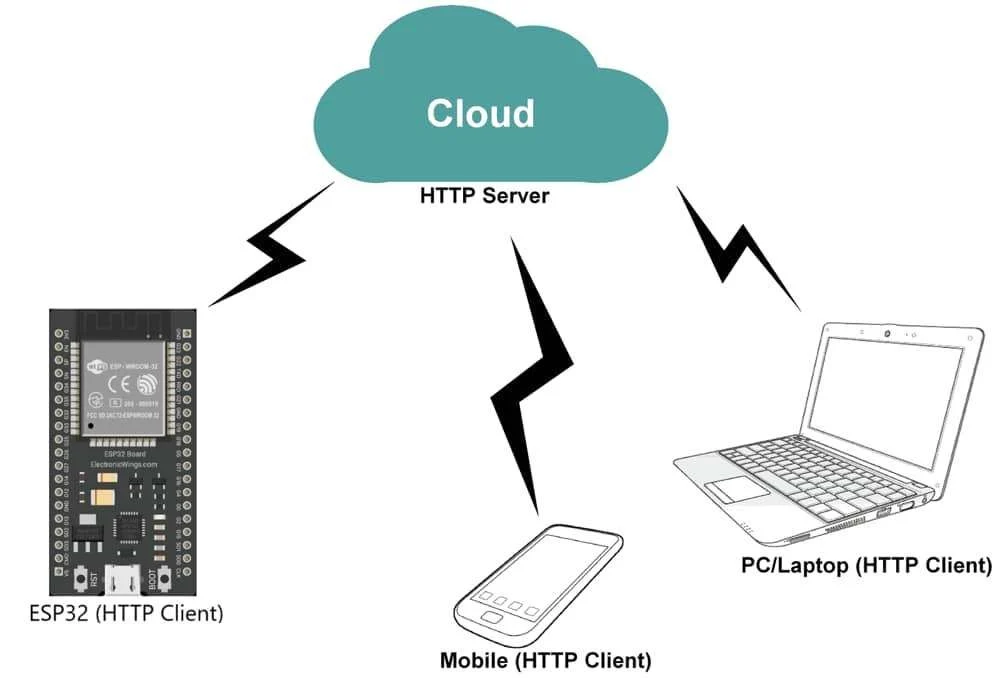
Microcontrollers such as ESP8266 and ESP32, equipped with built-in Wi-Fi connectivity, act as edge devices in IoT systems. These devices collect data from sensors, preprocess it, and transmit it to cloud platforms using standard communication protocols.
This experiment demonstrates how an ESP-based device and a cloud platform work together to form a complete IoT system, enabling real-time monitoring, historical data analysis, and remote accessibility.
Role of Cloud in IoT Systems
In an IoT architecture, the cloud layer performs multiple critical functions that extend the capability of edge devices.
The major roles of the cloud in IoT systems include:
- Receiving sensor data from multiple IoT devices
- Storing large volumes of data in cloud databases
- Providing real-time dashboards for visualization
- Exposing APIs for data access and integration
- Enabling remote monitoring and control
- Supporting analytics, alerts, and automation
Without cloud integration, IoT systems remain local, isolated, and limited in scalability. Cloud platforms enable centralized management and global accessibility of IoT data.
ESP8266 / ESP32 as Cloud-Connected IoT Devices
ESP8266 and ESP32 function as cloud-connected IoT nodes that bridge the physical world and the digital cloud.
These microcontrollers perform the following tasks:
- Reading sensor data using analog or digital pins
- Connecting to Wi-Fi networks using stored credentials
- Formatting sensor data into HTTP or MQTT payloads
- Sending data to cloud servers
- Receiving acknowledgments or commands from the cloud
ESP8266 / ESP32 support multiple communication mechanisms, including:
- HTTP / HTTPS
- MQTT
- REST APIs
This flexibility allows them to integrate with a wide range of cloud platforms and IoT services.
General Cloud–ESP Communication Architecture
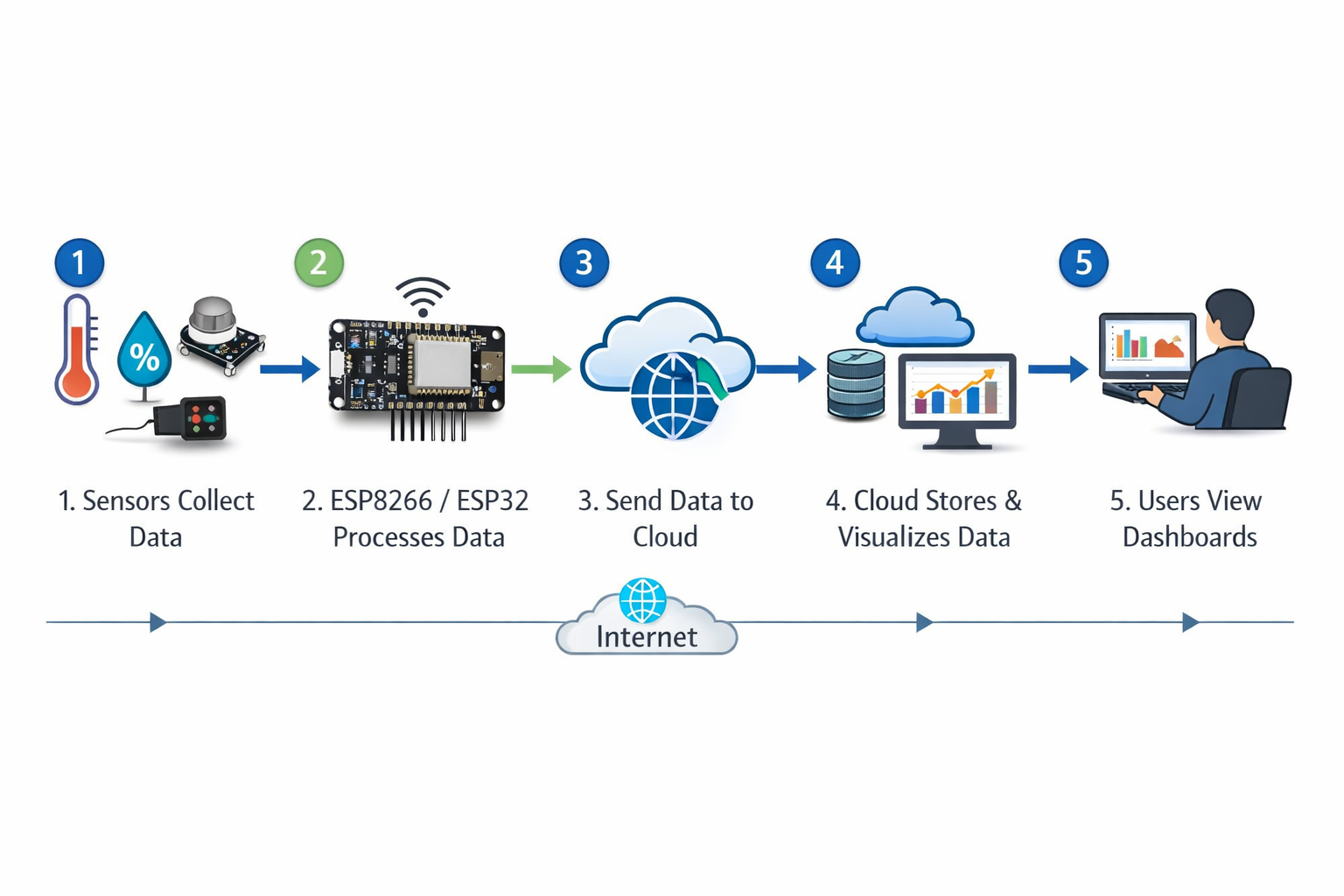
The general communication flow between sensors, ESP devices, and cloud platforms is illustrated below:
- Sensors collect physical or environmental data
- ESP8266 / ESP32 reads and processes sensor values
- Processed data is transmitted to the cloud via the internet
- Cloud platform stores and visualizes the data
- Users access dashboards and analytics remotely
This architecture separates data acquisition, data transmission, and data visualization, making IoT systems modular and scalable.
IoT Cloud Platforms Overview
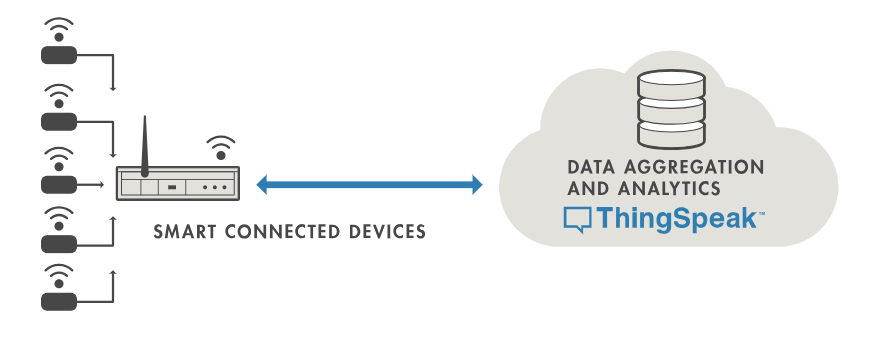
IoT cloud platforms provide ready-to-use services for managing IoT data and devices. These platforms eliminate the need to build custom servers and dashboards from scratch.
Common features of IoT cloud platforms include:
- Secure data ingestion APIs
- Real-time and historical data visualization
- Device authentication and management
- Analytics and alert mechanisms
Popular IoT cloud platforms include:
- ThingSpeak
- Firebase
- Blynk
- AWS IoT
- Custom REST-based servers
ThingSpeak Cloud Platform
Overview of ThingSpeak
ThingSpeak is a cloud-based IoT analytics platform widely used in academic laboratories, research projects, and Virtual Labs. It provides a simple and effective environment for storing, visualizing, and analyzing sensor data.
ThingSpeak allows users to:
- Create data channels
- Store sensor readings
- Visualize data using graphs
- Perform MATLAB-based analytics
Its simplicity and REST API support make it ideal for educational IoT experiments.
ThingSpeak Channels and Fields
A ThingSpeak Channel represents a data container for sensor values.
Key characteristics:
- Each channel can contain up to 8 data fields
- Each field corresponds to a specific sensor
- Time-stamped data storage
Example field mapping:
- Field 1 → Temperature
- Field 2 → Humidity
- Field 3 → Gas Level
This structured format allows systematic organization of sensor data.
ThingSpeak APIs
ThingSpeak provides REST-based APIs that allow interaction between ESP devices and the cloud.
Write API Key
Used by ESP8266 / ESP32 to upload sensor data securelyRead API Key
Used by applications or dashboards to retrieve stored data
Sensor data is typically sent using:
- HTTP GET requests
- HTTP POST requests
API-based communication ensures controlled and authenticated data exchange.
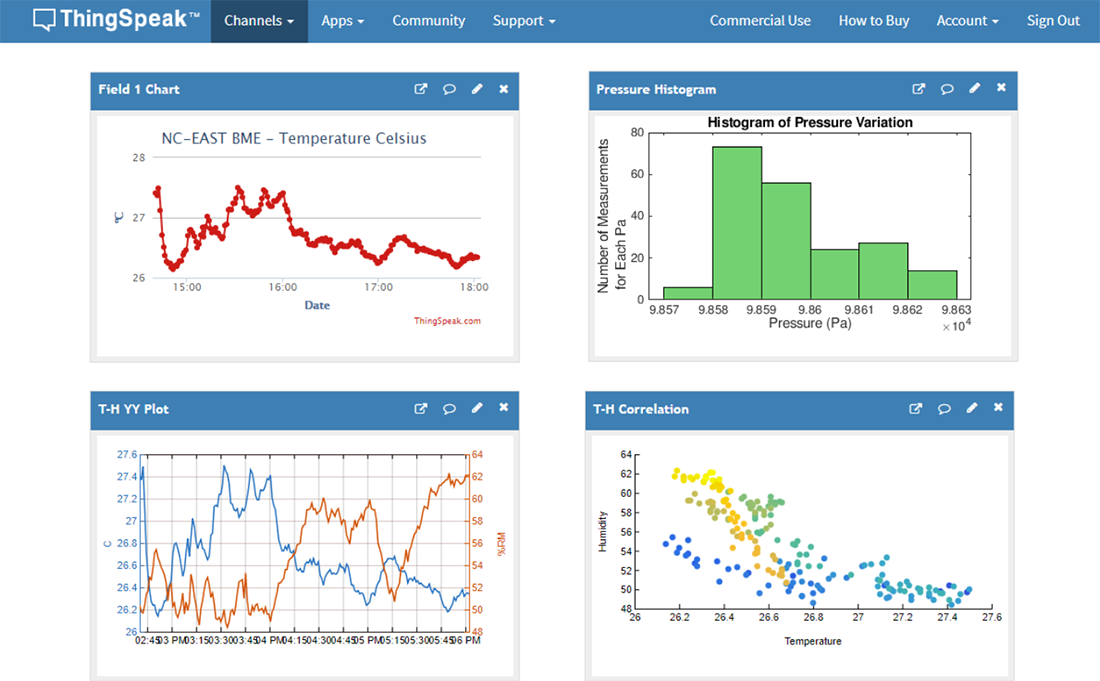
ThingSpeak Dashboard Visualization
ThingSpeak automatically generates visual dashboards based on received data.
Visualization features include:
- Line graphs
- Time-based plots
- Real-time data updates
These dashboards enable:
- Remote monitoring of sensor data
- Historical trend analysis
- Debugging and performance evaluation of IoT systems
Data Retrieval and Cloud APIs
In addition to data upload, cloud platforms allow data retrieval through APIs.
Using Read APIs, applications can:
- Fetch historical sensor data
- Integrate data with mobile or web apps
- Perform external analytics
This bidirectional interaction establishes a strong interrelation between cloud platforms and IoT devices.
Applications of Cloud–ESP Integration
Cloud-connected ESP-based IoT systems are widely used in:
- Smart agriculture monitoring
- Weather stations
- Smart home automation
- Industrial IoT systems
- Healthcare monitoring platforms
Conclusion
This experiment provides a comprehensive understanding of the interrelation between IoT cloud platforms and ESP8266 / ESP32 microcontrollers. By studying cloud-based data storage, visualization, and API-driven interaction, learners gain practical knowledge required to design scalable and remotely accessible IoT systems.
References
References
[1] MathWorks, “Getting Started with ThingSpeak.” [Online]. Available: https://thingspeak.com/docs
[2] Espressif Systems, “ESP32 Documentation: Connecting to Cloud Platforms.” [Online]. Available: https://docs.espressif.com
[3] Adafruit Industries, “DHT22 (AM2302) Temperature-Humidity Sensor Guide.” [Online]. Available: https://learn.adafruit.com
[4] MathWorks, “MATLAB IoT Analytics: ThingSpeak Cloud Tutorials.” 2020.
[5] R. Santos, “ESP32 Data Logging to ThingSpeak.” Random Nerd Tutorials, 2021.
[6] Amazon Web Services, “AWS IoT Core Developer Guide.” [Online]. Available: https://docs.aws.amazon.com/iot
[7] A. Botta, W. de Donato, V. Persico, and A. Pescapé, “Integration of Cloud Computing and Internet of Things: A Survey,” Future Generation Computer Systems, vol. 56, pp. 684–700, 2016.
[8] L. Atzori, A. Iera, and G. Morabito, “The Internet of Things: A Survey,” Computer Networks, vol. 54, no. 15, pp. 2787–2805, 2010.
[9] M. Chiang and T. Zhang, “Fog and IoT: An Overview of Research Opportunities,” IEEE Internet of Things Journal, vol. 3, no. 6, pp. 854–864, 2016.
[10] S. Li, L. Da Xu, and S. Zhao, “The Internet of Things: A Survey,” Information Systems Frontiers, vol. 17, no. 2, pp. 243–259, 2015.